February 1, 2026
Cowbell University: A Lesson from History
In a previous lesson, I wrote about the well-known Saturday Night Live skit where the solution to every musical problem was simple: I gotta have...more cowbell.
It was funny because it felt familiar. We've all been in rooms where someone responds to a challenge not by rethinking their approach but by turning up the volume on what's worked for them before. More effort. More intensity. Same-o, same-o.
Since that lesson, I've noticed cowbell more often in many songs, and most would be poorer without it. The lesson isn't that cowbell is never the answer. It just depends.
History gives us a powerful illustration of this tendency in the contrast between ancient Sparta and Athens at Pylos.
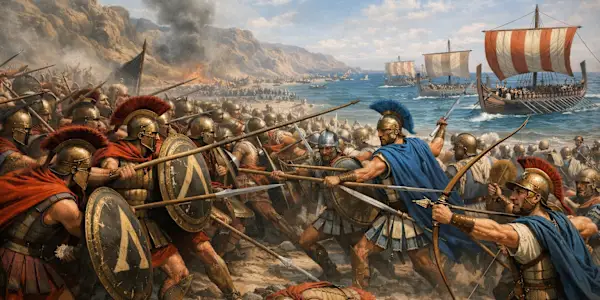
Remember the movie 300? It's basically targeted to those for whom the violence in Braveheart wasn't graphic enough. The film is all about the Spartans and their stand at Thermopylae. For centuries, Sparta has been celebrated as the ultimate warrior society. Spartan males were trained from early childhood for combat, and discipline was ruthless. Spartan soldiers were widely regarded as the finest heavily armed citizen-soldiers in ancient Greece.
So, when Sparta faced a military problem, its instinct was predictable: more Sparta. Better discipline. More rigorous training. Greater sacrifice. More cowbell.
And to be fair, Sparta's strength was the real deal. In direct land battles on open ground, their tight rectangular formations with overlapping shields were formidable. But over time, that strength hardened into assumption. What made them great in one situation was assumed to make them great in all of them. The system produced excellence, but only within a narrow band.
That became painfully clear in Sparta's war with Athens.
At Pylos, on the southwestern coast of Greece, Sparta suffered a stunning defeat at the hands of the Athenians. Athens knew it couldn't outfight Sparta on land, so it refused to fight by Spartan rules. Instead, it leveraged naval power, geography, patience, and time. Light troops, harassment, and control of supply lines replaced heroic, set-piece battles. The approach reflected Athens' broader strategic mindset: avoid decisive land battles, protect the population behind walls, and rely on naval dominance to weaken the enemy indirectly.
Athens understood something Sparta didn't at the time: winning isn't just about doing what you do best; it's about doing what works in your current situation.
In modern terms, Athens thought systemically. It aligned military capability, economic strength, political structure, and geography into a coherent whole. Sparta optimized a single function brilliantly. But Athens optimized the entire system.
It reminds me of a lighter—but telling—experience from time in Guatemala last year. Our group had decided to teach our local hosts the new (to them) game of "rock, paper, scissors." But no matter how we continued to explain how to play, they chose to use their own rules. Every time we counted "three," they would wait an extra beat, look at what we'd chosen, and then select whatever trumped ours. Their punchline landed every round. It was hilarious—to us and to them. But as long as we played by Guatemalan rules, we Americans lost every time.
Ironically, Athens eventually lost that Peloponnesian War—but not because its original strategy was flawed. It lost because it abandoned it. The disastrous Sicilian Expedition was not a failure of resources or intelligence but of restraint. In Athens' case, it added cowbell when it should have stayed with its current tune.
So, Sparta did eventually figure out where they'd failed and won the war. They borrowed money from Persia, built a navy modeled after Athens', and fought the very kind of war they'd previously resisted. Even in victory, Sparta was forced to become less Spartan. Finally, they adapted their approach.
The deeper lesson here isn't about ancient Greece. It's about human nature. We're wired to trust what's worked for us in the past. Success builds confidence, and confidence easily hardens into habit. Over time, our habits become part of our identities. When new challenges arise, we instinctively reach for our strongest—and often favorite—tool, assuming the answer is simply to apply it with greater force.
Organizations do this when they cling to products long after conditions have changed. Leaders do it when we mistake intensity for insight. And individuals do it when we assume the skills that brought us early success will continue to offer fulfillment later in life. (Hint: they often don't!)
I still love a good cowbell under the right conditions. But wisdom lies in knowing when "more" is no longer the right choice. Sparta teaches us the danger of mistaking excellence for universality. And Athens reminds us that adaptability isn't always weakness, it's intelligence. Both warn us that even the best strategy can be undone by ego, impatience, or a general inability to "read the room."
Moving through life, the question isn't whether we still have cowbell to offer. It's whether we can recognize when the music has changed—and whether we're willing to try something else that could work better. I'm continuing to learn that finishing well often requires less volume and more discernment regarding my choices.