June 28, 2026
Frozen in Time
One of the more sobering realities of aging is realizing the people we often remember no longer exist.
I recently happened across a photograph from my high school days. There I was, along with classmates, most of whose faces I would still recognize, despite having not seen them in years. The photo brought back memories of school events, classrooms, friendships—and a strange thought occurred to me. None of the versions of those people I remember really exist anymore.
The old photograph captured a moment. But it was never capable of capturing the full story.
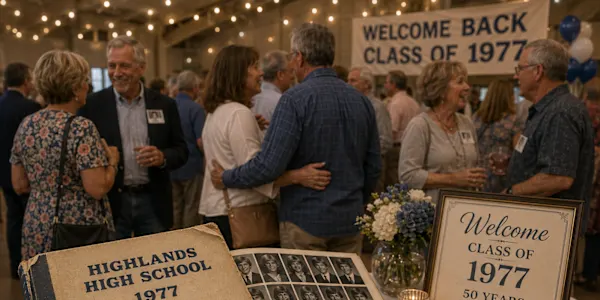
Next year, a group of us will attend our fiftieth-year high school reunion. For some, it will be the first time in years we'll have seen one another. I'm guessing some classmates will walk through the door looking much as we might have imagined. Others could surprise us. I suspect most, if not all, will have become wiser, kinder, and more grounded than the teenagers we remember. Still others of us may bear the visible effects of difficult choices or difficult circumstances.
Photographs preserve moments, but they never preserve lives. And I've come to realize that photographs aren't the only things that appear to freeze time. We do the same thing with people.
We all carry pictures around in our minds of an old friend, a difficult coworker, someone who disappointed us, a relative who hurt us years ago, or maybe a gifted athlete who once seemed destined for greatness.
Years pass, but those pictures remain. Without realizing it, we often continue thinking of people as who they were in those images. In some ways, we're responding to tiny snapshots instead of their full stories.
This realization has become increasingly apparent to me in a setting I never planned on. Recently, I began teaching one of my college courses inside a Tennessee prison. Before my very first classroom visit, I naturally carried certain assumptions about who I'd be working with. Prison is a place where its very existence is based on a set of crimes, convictions, and sentences to be served.
But after only a few visits, something unexpected began happening. I noticed I was increasingly seeing students instead of inmates. My new students study, ask questions, help one another understand difficult concepts, worry about grades, and procrastinate on assignments. In so many ways, they behave just like the students I taught throughout my career.
What makes this realization even more striking, though, is that many of my current students are serving sentences for violent crimes, and some will spend the remainder of their lives in prison.
The whole experience has forced me to confront an uncomfortable truth. Many of the men sitting in front of me have now lived decades beyond the poor choices they made hastily in their youth—the choices by which society still views them. Each has continued learning, aging, reflecting, regretting, growing, and most of all, changing. Whatever else might be true about them, society still tends to define them by a single chapter of their lives.
Shouldn't it make each of us uncomfortable when others freeze us in time? We don't want to be permanently defined by a horrible choice we made years ago. We don't want to be remembered for our bad decisions, past failures, or a season of life we've since left behind. We hope people will recognize that we've learned, matured, and grown.
Despite this, we often struggle to extend that same grace to ourselves. We continue dragging around those old photographs of who we used to be. Some capture our failures—a poor choice, a missed opportunity, a relationship we blew up. Others capture our better moments, when our bodies were stronger, our minds sharper, and our futures seemingly limitless. Either way, we begin treating the photograph as though it's current. It's not.
As I thought about those old photographs, I began noticing how often Scripture describes people as works still in progress. Paul says in II Corinthians 5:17, "This means that anyone who belongs to Christ has become a new person. The old life is gone; a new life has begun!"
Our Christian life is so much more than what happened to us in yesteryear. Or even yesterday. It's about what God is doing in us right now and the work that will continue as times passes.
When God called Gideon a mighty warrior, Gideon was hiding in fear. When Jesus renamed Simon as Peter, Peter hadn't yet become the cornerstone rock his new name implied. When God chose David, even his own family saw only a young shepherd boy. For each person, God could of course see beyond who they were in that moment. He was declaring who they would become based on His presence in their lives.
God doesn't do what we do confining people to a snapshot. He sees our failures, but He doesn't define us by them. He sees our strengths but isn't impressed by them. He sees the entirety of our story in a way we never can.
That perspective should change how we view others and ourselves. None of us are only our greatest successes or failures. Neither are we the frightened teenagers, ambitious young professionals, exhausted parents, or even the aging retirees awkwardly doing our best "cheese" for a family pic.
We're the sum of all our chapters—stories still being written.
It's the same with the photographs that I look back on of my previous selves—Joe 17.0 and 42.0, as examples. Those younger versions could never have imagined all that would follow—the joys, the disappointments, the lessons, the blessings, the failures, and of course, the grace.
If God grants us additional years, today's photograph won't tell the full story either. We look at a current picture and think, "There I am."
The old photograph captured a moment. But it was never capable of capturing the full story.
God looks at the same image and says, "I'm not finished with you, yet."