January 11, 2026
You're Smart. (And So Are They).
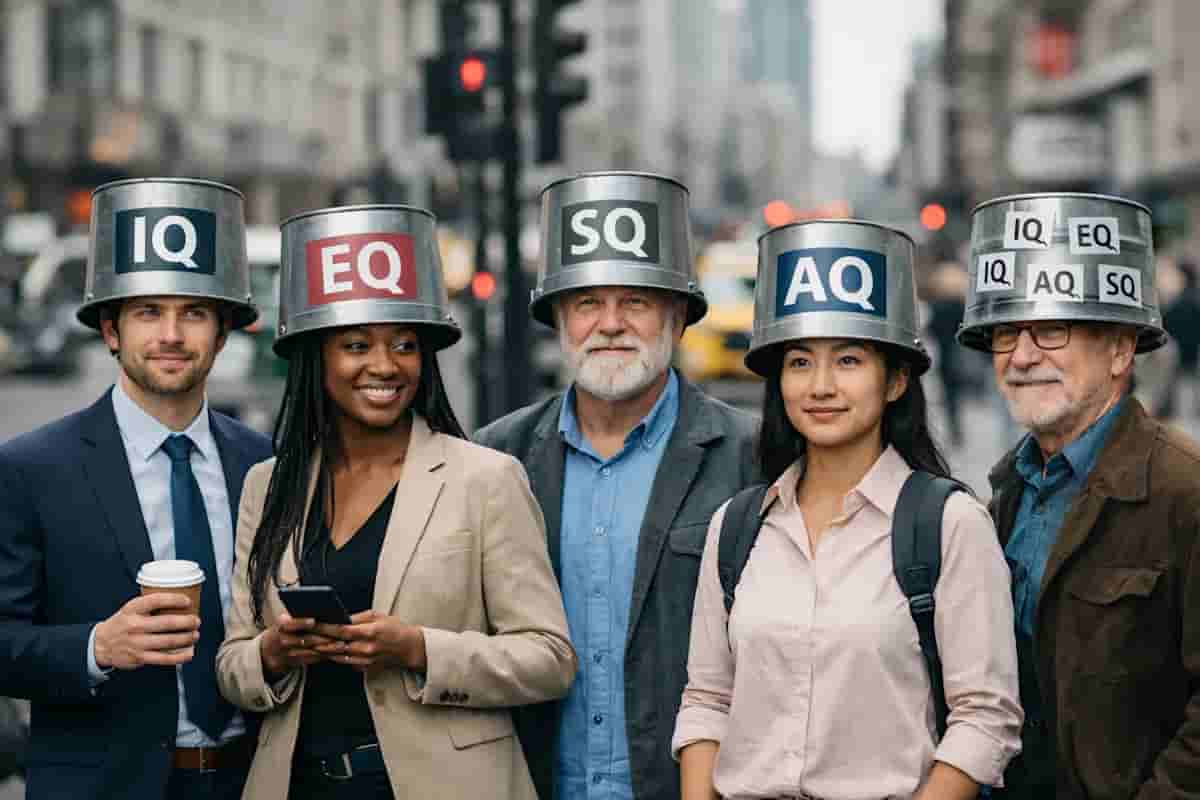
For most of our lives, we've been taught to think of intelligence in very narrow terms. At some point in school, most of us were assigned a number, a percentile, or a label, and over time we learned—often without realizing it—to let that measurement shape how we size up ourselves and others.
We decide who is "smart," who's merely capable, and who might not even be worth listening to at all. Rarely do we stop to consider how much we might be missing when intelligence is defined too narrowly.
Over many years I've come to believe that God gives each of us a bucket of smarts—a set of capacities we're born with but then he brings us opportunities to develop them over a lifetime. That bucket is real for everyone, but it's anything but filled with the same stuff. Some of us receive a heavy pour in areas our culture readily recognizes, while others receive gifts that are quieter, less celebrated, and harder to measure.
Over my career, I worked with many individuals who could knock the top off an IQ test—brilliant thinkers by any technical measure of intelligence. And yet, some of those same individuals struggled profoundly to work well with others. In fact, in some cases, their participation could lead to a team performing worse, not better. Their traditional intelligence was undeniable, but it was narrowly concentrated in one specific type.
We might see similar contrasts in various professions. What about a surgeon, for example, who is astonishingly gifted in the operating room and produces consistently spectacular outcomes? Yet when it comes to bedside manner or interacting with colleagues, he or she might actually be a discouragement to others. That individual's technical intelligence? Outstanding. But relational intelligence? Hmmm.
Which raises an important question: What kinds of intelligence or "giftedness" might we be actually valuing?
Mr. Rogers never dazzled the world with intellectual fireworks. He wasn't known for speed, cleverness, or academic prestige. Yet for decades, he shaped the emotional lives of millions of children. At least part of his genius was emotional intelligence (EQ)—a critical ability to understand feelings, regulate his own emotions, and create a space where others felt safe, seen, and valued. His bucket brimmed with EQ smarts, and the fruit of his giftedness continues to ripple even now. As he might say, "that's nice."
Mother Teresa wasn't celebrated for her scholarly brilliance or complex theological arguments. She possessed profound spiritual intelligence—a clarity of purpose, a deep alignment between belief and action, and an unwavering sense of calling. Her understanding of meaning, values, and service sustained her through decades of sacrificial work among the poorest of the poor. Her intelligence wasn't expressed through analysis but rather through extraordinary kindness.
The more we broaden our understanding of being smart or gifted, the clearer one truth becomes: intelligence is multifaceted at a minimum.
We all know about cognitive intelligence (IQ), and now we've introduced EQ and SQ. But what about AQ—the ability to handle challenges and exhibit resilience in the face of adversity? And SQ, the capacity to effectively navigate social situations? Many individuals on the autism spectrum demonstrate excellence in areas such as logical-mathematical, visual-spatial, musical, or even linguistic intelligence. Their giftedness might include abilities for intense focus, pattern recognition, exceptional memory, or possibly detail orientation.
Here's the rub. I can honestly say I've never met an individual who excelled in all of these areas. Most of us are fortunate to be exceptional in one area!
But some of the most impressive people I've ever known weren't extreme outliers on any single dimension. They were simply balanced.
Most of us would agree Abraham Lincoln was impressive. Mostly self-educated, his life was marked by repeated failure, loss, and disappointment. And yet, he demonstrated remarkable emotional restraint, moral clarity, resilience under pressure, and an ability to hold competing tensions without becoming rigid or reactionary. His strength didn't come from knocking the top off any one intelligence measure. It came from a rare integration of several skills—developed slowly, painfully, and faithfully over time.
Yet many of us quietly judge others as average—or worse—because their gifts aren't the kind we've been taught to value or can even spot with limited interaction.
Which leads to a simple but uncomfortable conclusion: When we define intelligence too narrowly, we don't just misjudge people—we diminish them.
What if, instead of dismissing a person because their bucket isn't filled with the stuff we define as "smart," we approached them with curiosity—and an expectation that God gave them other kinds of giftedness if we would only take the time to get to know them?
Once again, I'm talking to myself here as well, but I suspect we'd appreciate people far more deeply if we did that. And in the process, we might finally begin to view intelligence not as a competition, but as a carefully designed tapestry of complementary gifts.