November 9, 2025
Getting Your Head Above the Clouds
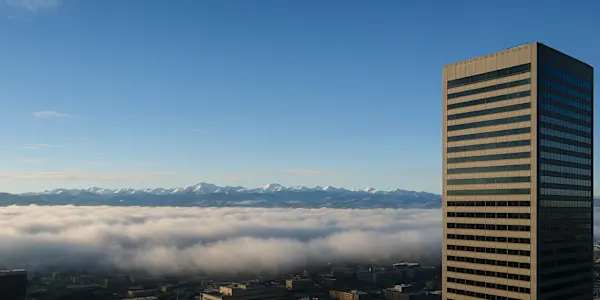
It was a Colorado winter morning more than twenty years ago. The kind of day that starts gray and stays that way — cold, wet, and full of that mix of snow and sleet that makes you question why you ever agreed to drive anywhere. For those who read my book, it felt like a Wednesday. On my dean's calendar that day was a set of fundraising appointments in downtown Denver, calling on prospective donors for our business college.
Unfortunately, the weather wasn't bad enough to cancel. I-25 south was slick, visibility low, and everything outside the windshield felt dull and colorless. When I finally parked near what I think was Republic Plaza — then Denver's tallest building — I remember thinking how few people were out and how miserable the day felt as I hurried along the slushy sidewalks to my first appointment.
I entered the building's lobby, stepped into the elevator, and began the long ride up. But as I was rising, everything was changing — I just didn't know it yet. When the elevator doors opened on one of the top floors, I stepped out into bright sunlight.
It felt as though my whole world had been transformed. Outside the large office windows stretched a panorama of clear blue skies, with the snowcapped Rockies glowing in the distance to the west. I remember walking straight toward the large conference room's outer glass, almost in disbelief. Once my host had entered the room, I greeted him and then walked over closer to the edge and looked down. The city below was still buried in gray clouds — I was simply above them.
I turned to my host and said something like, "I can't believe this view." But the thought that stayed with me wasn't just about the incredible panorama of how far and wide I could now see or even the snow-capped mountains mostly to my right. It was about how drastically different everything looked from that altitude. I was standing in almost the exact same spot where I'd been moments earlier. But my altitude was now very different, and so was my perspective.
Driving home that afternoon, that image wouldn't leave me: the same world, the same weather, but two entirely different realities depending on my altitude.
It's Messy Down There. Much of leadership, of course, does happen at ground level — in the noise, the urgency, and the constant churn of decisions and details. By nature, it's going to be messy a lot of the time, and from that low altitude, the horizon can look cloudy. We may start believing the organization is stuck, people are the problem, there are so many fires to put out, or the future is far from certain. But often, the real issue isn't the condition of the organization — it's the altitude of the leader and an inability to see anything but the messiness.
Altitude is Intentional. We may not always understand what's possible when we intentionally ride our elevators, but it's not exactly a secret at this point that clarity, vision, and perspective tend to come from spending enough time higher up. Grasping those prized concepts is far less likely to be found in the day's inbox or one's next meeting agenda. It's far more likely we get those when we intentionally "ride the elevator" — setting aside regular time to rise above the swirl and look at our organizations from a different vantage point. That might mean an offsite retreat, a regularly scheduled afternoon of reflection, a conversation with an external advisor or mentor, or even a quiet walk without one of our worst altitude enemies—our iPhones.
See the Forest for the Trees. In one of the most memorable scenes from Dead Poets Society, Robin Williams' character, John Keating, has his students literally stand on their desks so they can see the world differently. Keating reminds them that humans quickly settle into narrow frames, and unless we periodically change our vantage points, we stop truly seeing and fall into bad habits of merely noticing.
As leaders, when we change our frames by moving to that higher perspective, we tend to more readily identify larger patterns and the "bigger pictures" of what's happening across our organizations. In some cases, we may rediscover the larger purpose behind all the activity. And if we're fortunate, we might even be reminded that the sun was still shining all along — we were just mired underneath the clouds. Those views from the top can end up not only changing what we see but also what we feel!
Was my prospect visit a financial success that day? Not a clue. Never truly mattered all that much. But what I very much remember still was what that visit taught me. I now had a far better grasp of this altitude concept. Whether I was standing on the ground or up on the fifty-second floor, I was in the same exact spot on a map. And once I had ascended and then descended back to ground level, my perspective on where I stood was very different.
I believe good leadership requires those same intentional climbs and descent cycles from time to time in order to develop a richer and more informed understanding of one's organization.