April 26, 2026
Pendulums
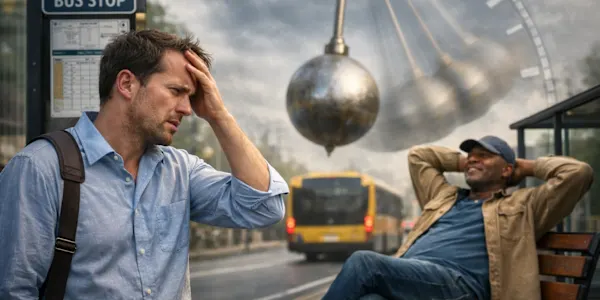
A man rushes toward a bus stop just in time to see the doors close and the bus pull away without him. He throws his hands up in frustration and mutters something about how the whole day is now messed up. Someone standing nearby glances at the schedule posted on the sign and calmly tells him, "Another one will be here in ten minutes." What had felt like a small calamity a moment earlier suddenly didn't seem quite so significant.
Ten minutes. If we remove sleep from the count, ten minutes amounts to one percent of the day.
But we've all had moments like the would-be passenger. Something doesn't go our way—a missed opportunity, a delayed plan, an unexpected problem—and it doesn't take much for us to let it take over more of our thinking than it deserves. A brief inconvenience begins to feel like a defining moment. If we let it, one small disruption can begin to shape the tone of our entire day.
Part of the reason for this is that we process too much of our lives near "the edges."
When something goes wrong, we tend to feel it immediately and intensely. It captures our attention, pulls at our emotions, and demands a response. But what we often miss is how little time we allow these negative moments to consume.
Life moves more like a pendulum than we tend to recognize. It swings back and forth, to be sure. But its movement is finite. It doesn't stay at the extremes. It passes through them in each direction—over and over.
And most of the time, our lives are quite ordinary. We live somewhere nearer the middle.
When we're honest, the majority of our days aren't defined by crisis or disruption. They're made up of ordinary moments that are steady and predictable—even uneventful. Yet those aren't the moments that tend to shape how we feel about our lives.
More often than we'd like, we tend to allow the extremes to do that—especially the negative ones.
Economist Vilfredo Pareto observed a pattern that's since shown up in countless areas of life. It's now labeled the 80/20 rule. Roughly eighty percent of outcomes tend to come from twenty percent of inputs. Businesses see it in their customers. Organizations see it in their results. The principle shows up a lot, and it can also be applied to how we experience our days.
A relatively small percentage of our time, when things go wrong, plans unravel, or frustrations surface—we allow those to have a disproportionate influence on how we interpret everything else. Whether we're dealing with a problem in the moment or simply anticipating one, that smaller portion can dominate our attention. I'm speaking for myself here as well.
We give twenty percent of our experiences far more than twenty percent of our focus. And in so doing, we allow them to shape our outlook in ways that aren't deserving.
Most of life doesn't happen in that space. In fact, a large majority of them live in the middle. A. W. Tozer once wrote, "A man is as holy as he chooses to be."
It's a strong statement, but in moments like these, it becomes surprisingly practical. We can't control every circumstance that comes our way, but we do have a say in how much of our attention it receives. We have a choice in whether a temporary frustration becomes a defining feature of our day, or simply a more deserved passing moment.
The missed bus is followed by another one in a few minutes. The frustrating conversation fades and is over. The unexpected problem is addressed, or it proves less significant than it first appeared. What felt defining frequently turns out to be transient, if we let it. Therein lies the key.
There's one other characteristic of a pendulum that I believe is worth noticing. Its movement is widest at the bottom of its swing. That's where the motion is most visible and most dramatic. At the very top, there's zero left/right movement. That upper "pivot point" is stable and still by comparison.
Of course, much of what we experience in life is more analogous to the bottom, where small changes feel large, where fluctuations are most noticeable, and where our perspective is most easily shaped by what's happening in the moment. Living there, it's easier to believe that everything is constantly in motion—that life itself is unstable, unpredictable, and so easily disrupted.
But that's not the only place from which life can be viewed, is it? Scripture invites us to a different perspective. We're reminded that God isn't subject to the same "motion sickness" we are. His view isn't shaped by the immediate swing of events, nor is it defined by the temporary extremes that so often capture and hold our attention.
"With the Lord one day is as a thousand years, and a thousand years as one day" (2 Peter 3:8). There's a steadiness with Him where our pendulums aren't subject to movement.
And to the extent we begin to see life more from that perspective, we're not just becoming steadier—we're becoming more aligned with Him.
As we begin to attune our thinking more closely with His—through His Word, through reflection, and through a growing awareness of what's true, we find that the swings that once felt so large begin to lose some of their momentum. We're living through the same events, of course. But we don't process them in the same way.
Most of what we're given in life isn't found at the extremes, but in the far steadier rhythms of ordinary days. And learning to live well is, in part, learning not to let the small share of extremes convince us otherwise.